
Build-up play from the back
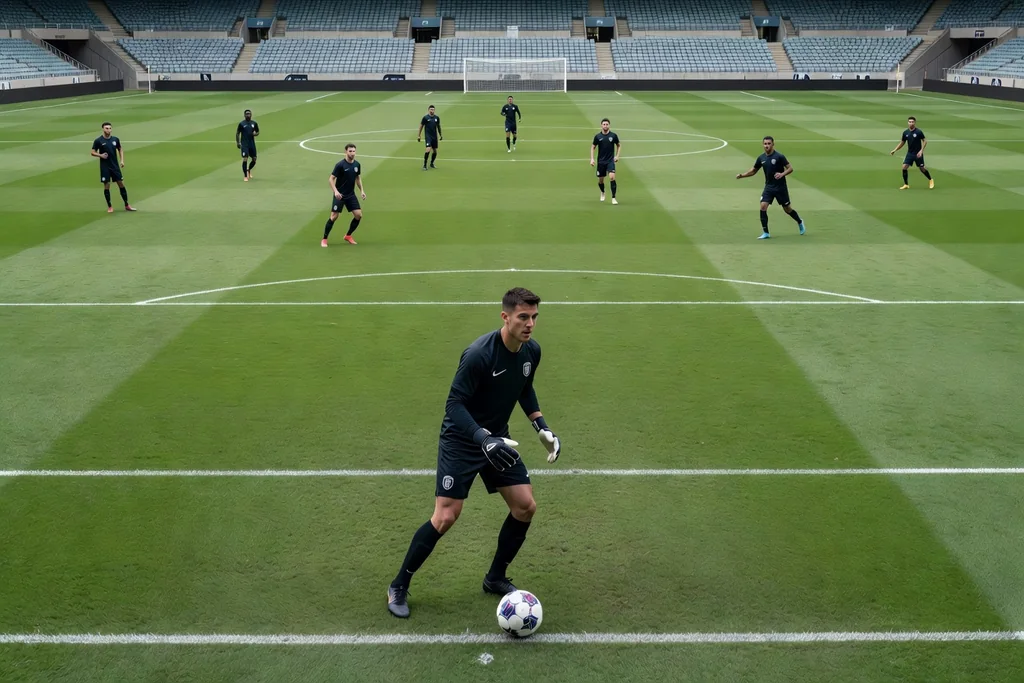
Build-up play is what happens when a team starts an attack from its own defensive third, usually with the goalkeeper involved. It is the phase of the game where a coach’s intentions are clearest, because the team has the ball, the opponent is organised and every pass has a purpose.
This article explains why teams build from the back, how they try to beat the first line of pressure, what makes a goalkeeper a genuine part of the system and what goes wrong when build-up breaks down.
Why start from the back at all
Playing out from the back is an attempt to control where the game is played. A long clearance concedes possession and invites the opponent to attack again, so a team that can pass its way out keeps the ball and moves the game into the opponent’s half on its own terms.
The second reason is numerical. By drawing the opponent forward, a team creates space behind the press. If the first line is beaten with a single pass, several opponents are suddenly out of position, and the team that played out has an advantage it would never have gained by kicking long.
The first line and how to beat it
The first line of pressure is the opponent’s forwards, and beating it is the central problem of build-up. Teams solve it in different ways. Some use the goalkeeper as an extra passing option, effectively creating an overload at the back. Others drop a midfielder between the centre-backs to receive under pressure. Others simply switch the ball quickly from side to side until a gap appears.
Each solution carries risk. Adding a player to the build-up leaves one fewer further forward; dropping a midfielder creates a hole if the pass is intercepted. The choice reflects what the coach trusts and where the opponent is weakest.
The goalkeeper’s role
Modern build-up has turned the goalkeeper into a footballer. A keeper who can pass accurately under pressure allows his team to keep eleven players involved in possession, and that extra player is often the difference between escaping the press and losing the ball in a dangerous position.
That comes with a specific risk, because a mistake by the goalkeeper is more costly than a mistake almost anywhere else. Clubs therefore recruit for the role deliberately, weighing distribution and composure alongside the traditional shot-stopping duties.
What makes build-up work
Successful build-up depends on a small number of repeatable principles rather than on individual brilliance.
- Creating a numerical advantage at the back to pass out of pressure.
- Positioning players between the opponent’s lines to receive.
- Using the full width of the pitch to stretch the press.
- Offering short options so the player on the ball is never isolated.
- Knowing when to abandon the plan and play long instead.
When build-up goes wrong
The failure mode is unmistakable. A loose pass in the defensive third hands the opponent the ball in a scoring position, and the cost is often immediate. That is why teams that build from the back must also be willing to abandon the approach when the press is too well organised, and why the best sides recognise the moment to go long rather than insisting on the plan.
Watching build-up
To follow build-up, watch the players behind the ball rather than the one carrying it. The shape around the goalkeeper tells you what the team intends to do before the first pass is played.
| What you see | What the team is trying | The associated risk |
|---|---|---|
| Goalkeeper with two short options | Overloading the first line of pressure | A misplaced pass near goal |
| Midfielder dropping deep | Receiving between the opponent’s lines | Losing the ball in a central area |
| Wide defenders very high | Stretching the press across the pitch | Space behind the advanced full-back |
| Long ball to a target player | Bypassing the press entirely | Possession given away cheaply |
| Rapid switch of play | Exploiting a press that has shifted across | Losing the ball across the pitch |
A phase worth understanding
Build-up is the part of the match where a coach’s plan is most visible, and it is therefore one of the most rewarding phases to study. Once you can see what a team is trying to do with the ball at the back, the rest of its game becomes easier to read as well.
The same exercise also explains why some teams look comfortable in possession and others never do. A side that has rehearsed its build-up has a plan for every pressing shape it might meet, and that preparation is visible in how calmly it plays when the opponent closes down. A side that has not rehearsed has to improvise, and improvisation in the defensive third is where most avoidable goals come from.
Read next
Formations and how teams shape up
What a formation describes, what it hides and how shape changes without the ball.
Set pieces and how they are prepared
Corners, free kicks and throw-ins treated as rehearsed routines rather than luck.